How to embed a video?
Embedding a video involves placing an<iframe> element on your webpage. By referencing the correct Bunny Stream embed url and including your video library and video IDs, you can display your video anywhere you like. Each embedded video is accessed via the following URL pattern:
<iframe>. For best results, we recommend using a responsive layout. If a fixed aspect ratio is required, a common approach is to use a container with a position:absolute;top:0;width:100%;height:100%; style, maintaining a standard 16:9 format or your desired ratio.
Example code:
How to embed vertical portrait (9:16) mobile video
Portrait (9:16) video is common for mobile-first content, short-form clips, and social-style players. By default, the Stream embed renders in landscape (16:9). This guide shows you how to adjust it for vertical video.Basic embed
The standard Stream embed code wraps the iframe in a div withpadding-top: 56.25% to maintain a 16:9 ratio:
To embed portrait video, you have two options: the wrapper approach (broader compatibility) or the direct approach (simpler, modern browsers only).
Option 1: Direct aspect-ratio (recommended)
For modern browsers, you can applyaspect-ratio directly to the iframe and remove the wrapper div entirely.
aspect-ratio: 9 / 16- locks the iframe to portrait proportionswidth: min(100vw, calc(100vh * 9 / 16))- scales the player to fill the viewport without overflow on any screen sizedisplay: block- removes the default inline gap beneath the iframe
This approach requires a browser that supports the
aspect-ratio CSS property (Chrome 88+, Firefox 89+, Safari 15+). For broader compatibility, use Option 2 below.Option 2: Wrapper div
If you need to support older browsers or want more control (e.g. overlaying UI elements on top of the player), use a wrapper div instead.- Sizing the wrapper div to the correct portrait dimensions
- Stretching the iframe to fill it absolutely with
position: absolute; width: 100%; height: 100%Use this approach when you need to layer overlays, captions, or buttons on top of the player.
Parameters
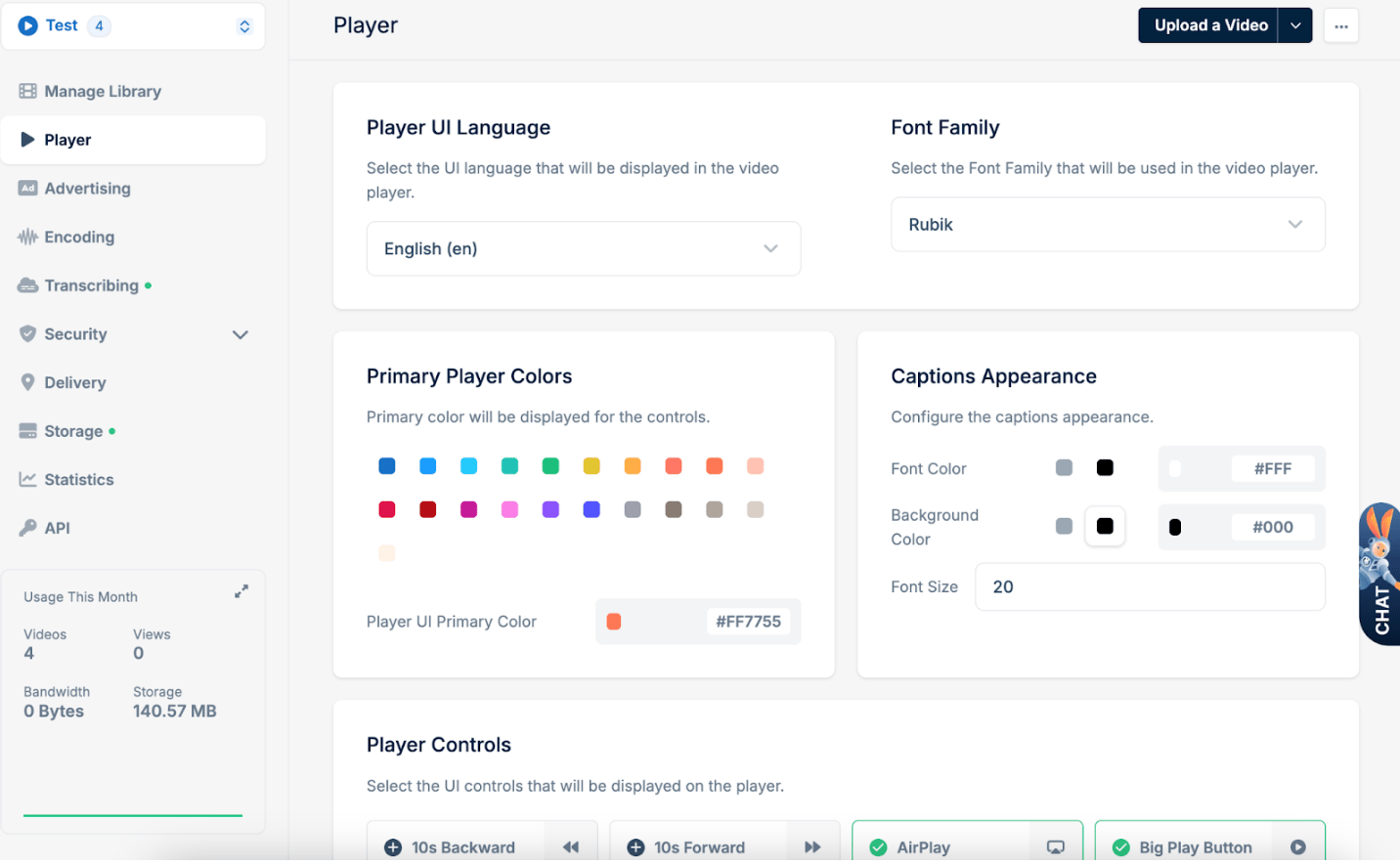
By default, many of the player’s controls and behaviors, such as captions, autoplay, and preload, can be configured on a global scale within the Player tab of your Bunny Stream library settings. Adjusting these default configurations ensures that any video embedded from that library inherits the same baseline behavior, providing a consistent user experience across all embedded instances.